



Why Sponsorship Value Matters for Brands and Broadcasters?
For decades, sponsorship in sports and live events followed a simple belief:
If the logo was visible, value was delivered.
That belief no longer holds. Today’s broadcasting ecosystem is more complex, more crowded and far more competitive. Sponsors are investing larger budgets, broadcasts are reaching global audiences and every second of screen time carries commercial significance.
Yet, one fundamental question remains surprisingly hard to answer:
How much real value did a sponsor actually receive from a broadcasted event?

The growing disconnect between sponsorship cost and proof of value
In most events, sponsorship revenue keeps the entire ecosystem running. Event organisers rely on sponsors to fund operations, production, talent, and distribution. Sponsors, in return, expect visibility, recall and brand lift.
But after the final whistle or closing ceremony, conversations often become uncomfortable.
Sponsors ask:
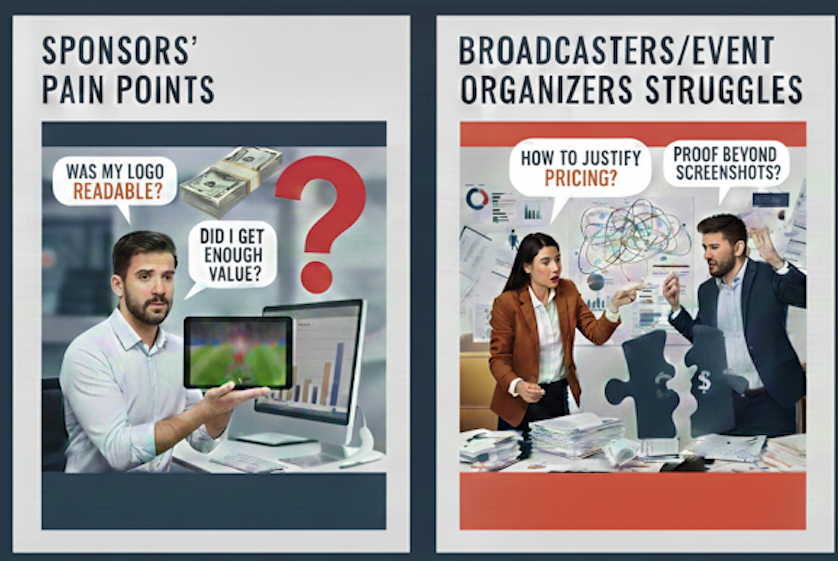
Was my brand visible enough?
Did I get more value than the supporting sponsors?
Was my logo actually readable to viewers?
Event organisers and broadcasters ask:
How do we prove value beyond screenshots?
How do we justify sponsorship pricing tiers?
How do we defend delivery during renewals?
A scenario almost every event professional recognises
Let’s take a very common example.
An event has:
- One title sponsor who paid a significant premium
- A few associate sponsors
- Several supporting sponsors
Naturally, the title sponsor expects:
- More screen time
- Better placement
- Higher visual dominance
- Clear differentiation from other brands
After the event, the title sponsor asks: “Show us how much value we received.”
If the response relies on statements like:
“Your logo appeared a lot”
“You had the best positions”
“The broadcast looked strong” …it is no longer convincing.
Modern sponsors expect numbers, comparisons, and proof.
Why visibility alone is no longer enough
A logo appearing on screen does not automatically mean value.
Consider these questions:
Was the logo on screen for half a second or five seconds?
Was it sharp and readable or blurred and partially hidden?
Was it large and central or tiny in a corner?
Did it appear once or consistently throughout the event?
Without measuring these aspects, sponsorship value remains assumed, not proven. This is why modern broadcasting is moving toward brand and logo exposure analytics.
What modern sponsors and organisers actually need
At its core, the need is simple.
Sponsors want:
- Clear proof of how much exposure they received
- Confidence that their investment made sense
Event organisers want:
- Data-backed sponsorship pricing
- Transparent reporting
- Stronger renewal conversations
- Long-term sponsor trust
Broadcasters and agencies want:
- Credible reports
- Fewer disputes
- A common language both sides understand
This shared need is reshaping how sponsorship value is measured.
How AI is changing sponsorship measurement
This is where tools like Sponsor Sense, the Brand and Logo Exposure Analytics product from BanyanBoard, enter the picture.
Instead of relying on manual observation, Sponsor Sense uses AI-driven video analysis to study broadcast footage frame by frame and answer questions that were previously impossible to answer accurately.
Not just:
Did the logo appear?
But:
How often did it appear?
For how long?
How clear was it?
Want to know more about Sponsor Sense?
If you’re an event organiser, broadcaster, brand, or agency exploring how to measure sponsorship value more accurately, you can learn more about Sponsor Sense.
Final thought
In the modern era of broadcasting, what gets measured gets valued.